

A room without a gender
The Internet as a posthuman container

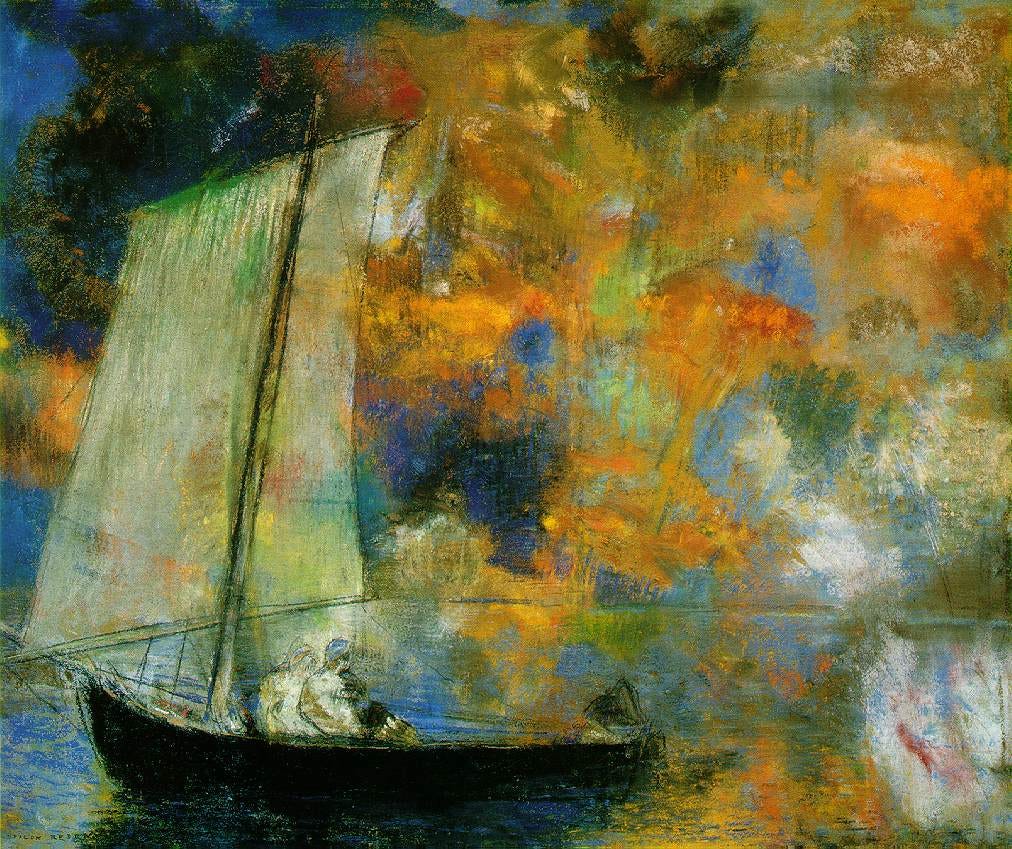
FOR MILLENNIA, WE HAVE FEMINIZED the containers of our lives. The earth itself has always been a woman: Mother Nature, Gaia, Terra Mater. Countries are typically always “motherlands”, and ships are traditionally referred to using feminine pronouns. Going even smaller, rooms have been thought of in the same way as well, but in a narrow context. Artemidorus of Daldis, the dream interpreter from the 2nd century AD, wrote in his text Oneirocritica that rooms in a dream “symbolize a wife, if there is one”. While the idea is certainly antediluvian in origin, Freud thought along similar terms in his canonical text on the subject in the nineteenth century. In The Interpretation of Dreams, he says that “rooms are usually women”. Yeah, he might have been on cocaine at the time, and Artemidorus on acid, but both musings follow the descriptive pattern we have maintained for the objects meant to shelter us.
The enclosures listed above generate metaphors that recognize our relationship to space as fundamentally intimate and embodied. We always live within something that can hold us, something which can protect. The newest and most consequential example we have in this lineage is undoubtedly the Internet. But the Internet is an “it”. It doesn’t serve its dwellers in the same way as a ship or country. There’s no sense of being supported at all, only of being dispersed and watched. We don’t enter it so much as we dissolve into it. It might just be because English is my native language (I will get to why this could be relevant shortly), but something bothers me about the Internet as an architecture without a gender at all. It signals a lack of reciprocity, a transactional emptiness incapable of expressing recognizable attitudes.
In my view, since its birth, the neutral label of the Internet was a harbinger for its posthuman constitution that is now readily apparent. It’s also one of the most recurrent rooms we find ourselves in.
All essays from The Moronic Inferno are allergic to likes & comments. Please share instead.
The early utopian theorists of the Internet wanted it to nullify gender. It would have no gatekeepers and provide access to everyone. Although the Internet has democratized access to information, the hope to make gender obsolete has, woefully, gone unfulfilled. Plenty of evidence suggests that gendered power imbalances, the marginalization and harassment of women, manosphere subcultures and other phenomena have flourished online. So the posthuman nature of the Internet does not suggest gendered dynamics never arise; quite the contrary.
In many languages, the grammatical gender of a noun predictably shapes how people describe it. For instance, a bridge is masculine in Spanish but feminine in German. The moon is feminine in Spanish and masculine in German. When asked to describe these objects, the adjectives people use depends on the language they speak. Bridges are more likely to be described as “strong” in Spanish and “elegant” in German, and so on. This slight difference changes the way we think about the world and the objects within it. To my knowledge, no scientific research has examined whether the Internet’s linguistic gender in other languages shapes the way people think about it. (I would welcome hearing from anyone who believes it does have an effect.) English, though, has no grammatical gender at all. Instead, when appropriate, we invoke it ourselves, as with ships, the sea, the country, and earth. Why haven’t we done that with the Internet? Is it androgynous? Does it just sound funky? Increasingly it feels genderless for a reason. The Internet is like a Rorschach test. It’s ambiguous by design, with a posthuman flavor to it. It’s a blank slate of infinite descriptors that does not answer to human signifiers.
Posthumanism is (big surprise) a contested term, but it’s charitable to think of it in a literal sense, as a combination of its prefix, root, and suffix. It’s a description for living in a state beyond the ordinary concept of being human, which, non-coincidentally I think, resembles the early futurist conceptions of the Internet. In one of the founding missives of the posthumanist vision, internet pioneer and Grateful Dead lyricist John Perry Barlow penned “A Declaration of the Independence of Cyberspace”. In the document, he argues that cyberspace is a realm without bodies, and that it would welcome anyone “without privilege or prejudice accorded by race, economic power, military force, or station of birth”. He argues that cyberspace — the world and all of its contents created within the Internet — would be a “civilization of the Mind”. Thought itself would be the primary object within this realm, unattached to the physical world. Identities are lost. Virtual, discarnate selves are born. He writes, “We will spread ourselves across the Planet so that no one can arrest our thoughts”. Back then, one surely wondered what thoughts could possibly be so grotesque, so bombastic and unforgiving, that an entirely new digital world would need to be created for them to be said out loud without any repercussions. We did not have to wonder for long.
Barlow clearly describes a philosophy and environment untethered to the law. In fact, the entire document is a declaration of sovereignty from the “Governments of the Industrial World”. The intent of this enterprise is separatist in nature, with the desire to move beyond all human conventions. Perhaps it’s not a great shock, then, that nobody from Silicon Valley has ever referred to the Internet with a human pronoun. The global computer network is meant to operate beyond those terms. Only a Mind is needed to float around in this digital kingdom. The Internet is meant to serve our cognitive faculties in a novel posthuman construction.
What experience, then, most resembles a disembodied mind adrift in a world of its own making? Freud and Artemidorus would recognize it instantly. Consider again the language used in Barlow’s declaration and compare it to the manifold of dreaming. The only remaining sanctuary in the modern world capable of being untouched, and incomparably private, is one’s dreams. They occur in the maddeningly peculiar harbor of the Mind. Our bodies don’t come with us. Nothing can happen to our corporeal selves without something going wrong in the physical world. We do not operate under the same moral or physical laws in our dreams. What this creates is a unique phenomenological experience, but now the state of dreaming can begin before we close our eyes, when we are ensnared by screens, as everything online comes together in a diffused, computational guise, under the direction of algorithms and the spectacle of engagement. The Internet progressively resembles the hazy, deterministically stupefied experience that occurs when dreaming, and operates on the logic and language of the unconscious.
The scholar Matthew Spellberg argues that to define dreams as the conscious material of sleep is too narrow. He suggests dreaming is a “state”, or “mode”, in which two characteristics are present:
The contents of our consciousness appear as the only reality
No reflective distance occurs
The first is easy. To be absorbed in the immediate stimuli of our feeds and digital platforms is a given, for chronic users especially. In this sense, Elon Musk seems to be permanently dreaming. What happens on the Internet frequently seeps into the physical world, as well. I remember from my callow high schooler days when a friend started a rebellion against me on Facebook. Apparently, unbeknownst to me, I was planning some kind of social takeover and had gained too many sidekicks and confidants in the process. This rebellion gathered followers, orchestrated strategies to defenestrate me, and of course, ensured that I saw their plot on Facebook. I genuinely thought I was watching myself lose friends in real time, as every interaction on the original post climbed higher and higher. It was daunting, to say the least, to enter school the next day. Yet I found no enemies waiting at the gate. The rebellion leader had no idea someone could be affected by what was obviously a joke, even the marginal fear that it might not be a joke. But I had lost no friends. Yet if I looked online, the roster of my foes would still be there. The Internet is not the only reality.
The lack of reflective distance is much more frightening. We are unable to watch ourselves in this mode of dreaming, and are at the mercy of our sensations. Surely everyone has tried to speak with someone who has their head tilted down, looking at the glistening contents on their phone. These people do not hear you. I have proclaimed my love for countless strangers and friends, and they will never know. My voice is like a ticking clock that goes silent once the mind is concentrated on something else. The frightening part is that most of us become these zombies multiple times throughout any given day, and we can’t help it.
Part of the experience of being online feels like Freud’s dream logic, specifically the concept of day residue. Hours of scrolling or other forms of online engagement can collapse into impressionistic fragments, where the emotional effect is retained and carried over into waking life. Of course, the Internet is not only social media. But every online activity produces its own residues; subtler, perhaps, but no less persistent. A major review in World Psychiatry demonstrates that sustained Internet use dramatically reshapes attention, memory, and social cognition. One’s online life influences one’s “online brain”. Every hour spent on the Internet distances us further from the people we would be without it.
Obviously, none of this would disappear if we simply began to imagine the Internet as a feminized container, but it does illustrate what’s lost when the Internet cannot be easily referenced that way. In this regard, consider the difference between a country and the Internet. To Silicon Valley hegemons, the Internet functions like their own country, but the two aren’t equivalent as social objects. A government official is bound to the state in a way that merges individual decisions with the will of a political body; the state itself acts as an “artificial agent.” David Runciman, in his book Handover, argues this kind of agency requires “a capacity to decide, to be held responsible, to persist as a subject over time.” The Internet meets none of that. It’s a puppet host, not a guardian. We hold our political leaders accountable when their negligence endangers a country or its citizens, but the same responsibility doesn’t attach itself in the same way to the stewards of the Internet. The Internet isn’t an end in itself. It’s only ever a means, one to which we owe no loyalty. And so when Silicon Valley leaders talk about the Internet using no gendered language at all, it reveals a posthuman detachment, one that we all have bought into, from what may be the most consequential container of our lifetime. These CEOs and other tech elites are the people who actually control how the public moves through this space, through discourse and commerce. But ask yourself if the digital world is truly in service of the old maxim from Terence: Homo sum, humani nihil a me alienum puto. Hardly, I’d say. Decisions from Silicon Valley are rarely made with human users in mind at all; engagement, growth, and shareholder value dictate the future of online life far more than any obligation to the people living inside it.
The modern world largely disregards the value of dreams. They are viewed as meager forms of entertainment, casually mentioned at the breakfast table at best, with no real import on material life. But antiquity shows us that much of the world thought the opposite, and indigenous cultures view dreams as the other pole of consciousness. They believe the dream world informs the waking world. This inspired dream sharing — a collective construction of narratives of both cognitive domains that communities formed in order to live cohesively, under a shared reality. Perhaps back then this was possible, as there was no digital realm to contaminate the experiences of the physical world. Now, though, we are in isolated states of dreaming, as the digital keeps us psychically and individually siloed.
In this otherworldly, recondite experience, we are being displaced (which, non-coincidentally, is another Freudian dream term). We have no choice but to call the Internet an “it” because it lacks any relational quality to our human selves. We have feminized the other containers of our lives because our agency is implicated in some way. There is no similar dynamic in the online world. This absence points directly to the posthuman condition, in which we are beings whose existence has become fused with technological systems that exceed our control. In this room, the human subject has been unseated from our previously distinct, central position. Where do we go from here?
That line stuck with me: "We don't enter it so much as we dissolve into it." That dissolution is the real horror beneath the grammar. The old feminine containers, rooms, ships, the earth, were vessels that received you, that held without capturing. The Internet's neutrality isn't androgyny. It's the alibi of a system that extracts what the vessel would have cradled. Maybe the missing gender isn't obsolete at all. Maybe it's the scar left when a room stops being a room and becomes a feed. You dream inside it because it refuses to be entered, so you can only be dispersed. That's not posthuman transcendence, it's homelessness wearing a sleek interface.
— Iman and Cassie