The linguistic cosmos
From inside Ukraine (part II)

“Through its street names, the city is a linguistic cosmos.” —Walter Benjamin
FOR THOSE FORTUNATE ENOUGH, innocence does not abruptly shatter. It endures a death by a thousand cuts before it fully evaporates. These sunderings offer miniature glimpses, like cracks through splintered wood, to peer into the world beyond the limits of childhood and adolescence. One of these moments is when you begin to notice that street names repeat themselves.
I was born in the state of Maryland. The shape of it is impressively bizarre; it’s also full of crabs, aggressive drivers, the home of Francis Scott Key, and generally agreed to have one of the coolest state flags in the country. I must have been belting “The Star-Spangled Banner” and too preoccupied with these other splendors to notice any variation in street names, if there was any, in my home state or its neighbors along the east coast. It was only when I drove across the country that I saw a duplicate in Kansas, after I turned onto a road that was supposed to only exist where I had grown up. But this continues to happen all over the world. It did not take long after I moved to England before it became apparent that nearly every street name back in America was unoriginal. We had stolen everything from a small island. For sure, sometimes these duplicates are neat. It’s nice to know that streets are named after Martin Luther King Jr. in France, Angola, Tunisia, Vietnam, and many others. But isn’t it all a bit slavish? Has anyone suggested to name streets after the smell of rain, highways after quadratic formulas, or boulevards after different pheromone types?
If anyone has, they were rejected. A recent study of seven world cities (London, Paris, San Francisco, Mumbai, New Delhi, Chennai, and Bangalore) found that most streets are named after men. On average, only 27.5 percent of the streets have female names. And, surprise, nearly all of them are the daughters or wives of famous men. Even if our species became creative enough to try and make every street name unique, the men would probably not allow it.
Each of us only has a given radius of diversity on the street. After a given number of miles we inevitably run into twin labels that denote the veins of a metropolis. But some people experience a change in their neighborhoods and cities before they have a chance to venture outside of them. I recently spoke with Yulia (a pseudonym, as she asked to remain anonymous) who has been living in Ukraine since the war began on February 24th, 2022, about the various ways in which everyday, ordinary life no longer looks the same, including the streets. In war and peace, the future is shaped by power, which is a force that burrows down into the core of everything, and leaves traces in the signs that hover above the roads on which we work and live.
All essays from The Moronic Inferno are allergic to likes & comments. Please share instead.
Yulia has lived in Kyiv for the past six years with her husband. Like many other couples, most of their relationship has now taken place under relatively constant air raid alarms. They were married in 2021. The following year, when the Russian invasion began, Yulia was three months pregnant.
“I woke up that morning to a flood of notifications on my phone,” she remembers. “I googled ‘war’ and saw headlines. ‘Putin has attacked Kyiv.’ ‘Kyiv is under attack.’ I thought I must be dreaming. I started shaking my husband. ‘Wake up, the war has started!’ He said to give him five minutes, and fell right back asleep,” she recalls.
Well, I do hope Darnya has some fun inventing emergencies more dire than war, if she ever needs to rouse her husband awake in the future.
“So I just lay there texting friends while he slept. Google Maps showed four-hour traffic jams on roads that normally take ten minutes.”
The instant Yulia and her friends turned to the internet to verify they were physically safe, even as smoke filled the sky overhead, now retrospectively looks as one of the early signals of how digital connectivity would disrupt the battlefield of war in transformative ways. The smartphone is officially a new weapon of information. Ukraine has integrated their general services platform with tools that allow the government to gather strategic intel, which is provided by civilians. For instance, if anyone sees a Russian soldier in their neighborhood, they can upload the location. The ability for anyone to provide information to armed forces has fractured the clear distinction between combatant and civilian. The digital realms offers a way for news to travel faster than bombs, of course, but it has also caused a new paradigm of thought in how sovereignty is impacted by the melding of state power and citizen participation.
These digital updates are still how Ukrainian citizens keep up with the latest information. “There are real-time news monitoring channels where you can see exactly which missiles are targeting which cities, almost as it happens,” Yulia explains to me.
“At night, if you hear a siren, you open the app and it says something like ‘three artillery shells over this district’ — and as you’re reading it, you hear them overhead. It sounds absurd, but it becomes almost administrative.” The ability to adapt to this twisted reality seems to be all too common.
Eventually, Yulia and her husband had to make a decision. They decided to temporarily split for the sake of their future child. Her husband stayed in Kyiv, and Yulia evacuated with a relative on a convoy out of Ukraine, a seat which cost a significant amount of money. Their son is now three years old, and loves Hot Wheels.
When Yulia returned to Kyiv, there were several changes to note. “Streets had been renamed. One street used to be called Tolstogo, after the writer Leo Tolstoy. It’s now named after a Ukrainian poet,” she says.
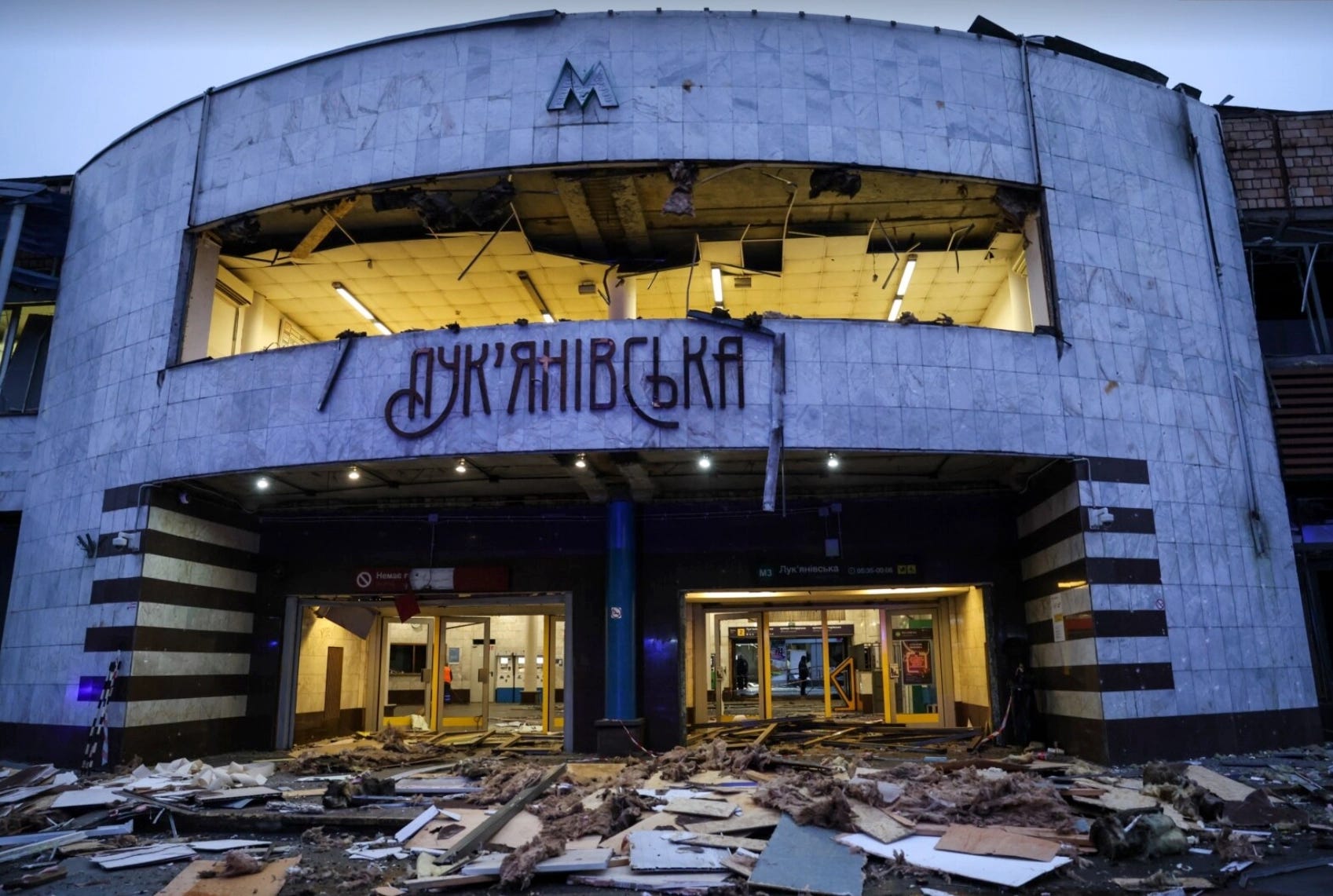
“Metro stations are being renamed, and holidays are being redefined. February 23rd used to be ‘Defender of the Fatherland Day’. It still is in Russia, but in Ukraine, it no longer exists in that form. They’ve chosen a different date and given it a different meaning,” Yulia tells me.
The erasure of Tolstoy is of particular interest. A prominent Russian writer, and one of the most enduring in all of history. The decision to scrap one of the commemorative pieces of his legacy illustrates how war operates largely in absolutes. Tolstoy’s contribution to world literature simply cannot be taken into account in the effort to scrub all traces of Russia from Ukraine’s capital city. For now, tributes are reserved for Ukrainians. When anyone looks up from the street, they will not see any remembrances for those born outside the country.
One of the first examples of renaming streets occurred during the French Revolution. The old Christian saints become irrelevant and were replaced by those in the resistance, as they engraved their names on street corners. Then in 1800, under Napoleon’s rule, there was a decree which mandated a revision of street names in Paris. Eventually, these new designations swung completely back into their pre-1789 form once the imperial regime met its end. Likewise, after the Islamic Revolution in 1979, Iran underwent a systematic effort to erase references to the former Pahlavi era and replace them with symbols of Shia identity. One of the many ways this occurred was through widespread changes in street names and public spaces. Commemorative street names are never set in stone. They are vulnerable to the political whims of the day which seek to reflect ideological preferences.
Ukraine has demonstrated another use, both symbolic and tactical, for street names during the war. Early on, Ukraine would scramble and remove their road signs to confuse Russian soldiers, so they would get lost and have absolutely no idea where they were. And wrong turns were not the only objective. Authorities posted signs to communicate to the Russians, as they illegally navigated their way through Ukraine, with rather bold declarations. One sign read: Putin lost, the entire world is with Ukraine. Perhaps this is why Yulia’s husband wanted an extra few minutes of rest. He was not afraid of Russia; a far greater threat would be necessary to invoke enough fear to jolt him awake.
Ukraine’s bilingual society also plays a major role in the evolution of this war. Yulia grew up in an industrial city in southern Ukraine, which just happens to be a region that predominantly speaks Russian. But after the war began, she made a deliberate decision to switch to only Ukrainian in her house. “I didn’t want to raise my kids Russian-speaking, like I was raised,” she told me.
Just as the names on the streets outside are changing, Yulia and others are making personal choices to consciously divert history in a new direction, for themselves and their children.
It’s these decisions which rebuild a city, a culture, a life, that define the Ukrainian resistance. It is common to believe that rebuilding only happens after butchery and destruction, but it has already started. Every day Ukraine rebuilds. Once, in just six hours people fixed a metro station that had been demolished. Twelve days to rebuild an entire dental clinic. And these are just the places which are ruined to the point of being uninhabitable. Otherwise, life goes on.
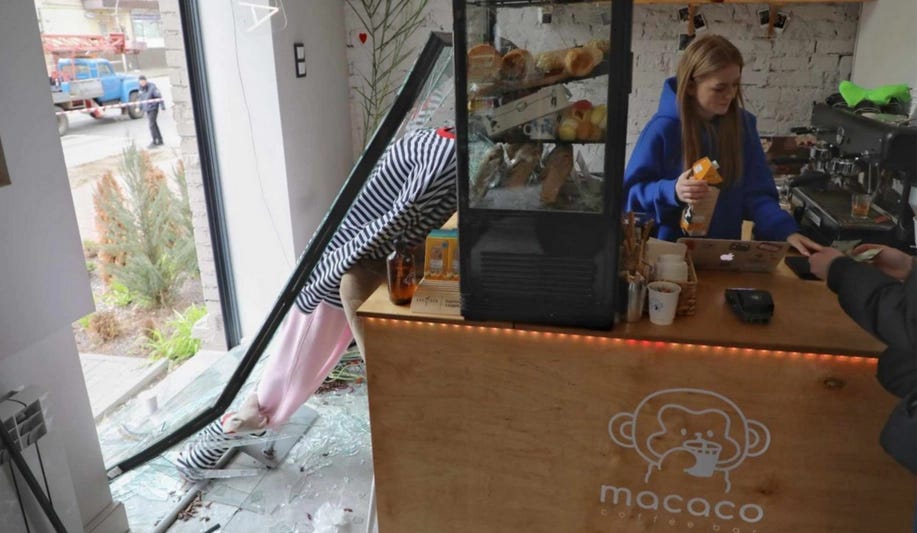
“I think changes have happened more in how I see the inner world — the people around me — than the outer world. After a night of attacks, you’ll see a café with blown-out windows,” says Yulia. “They’ll sweep up the glass, put up a sign saying ‘We’re open today’ and carry on serving coffee,” she says with a sense of awe and respect.
“I can’t imagine what would stop a Ukrainian business or person, if this hasn’t.”