
Goodbye to all that
A walk through the abandoned graveyard of modernity

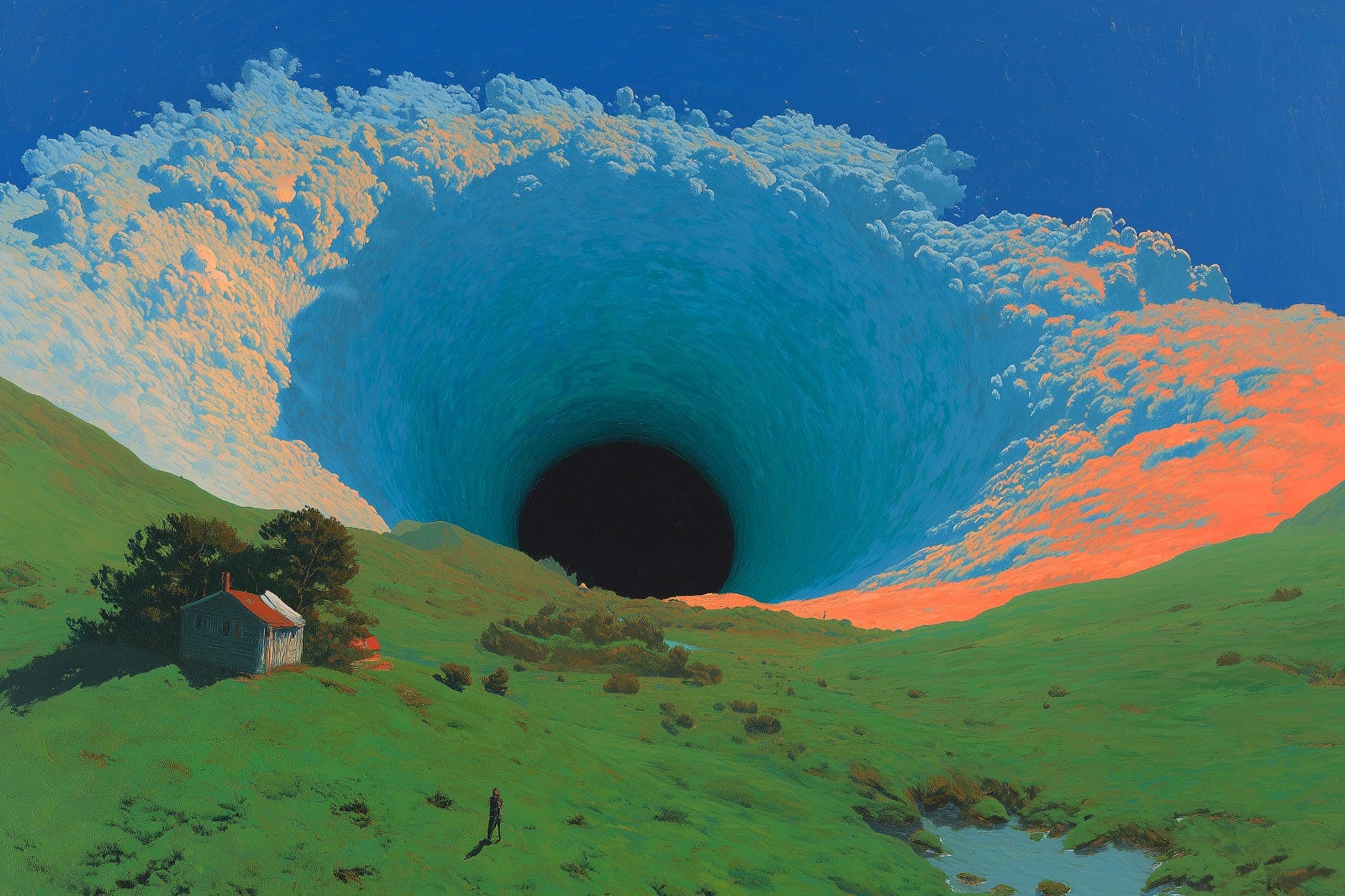
MANY THINGS DISAPPEAR FROM THIS WORLD. Earth might appear like a flourishing garden, with all of the equitable wages, thriving job market, affordable housing — scratch that — Labubu dolls, ice baths, reaction videos, aura farming, AI slop, TikTok reels, etc. And hey, I get it, that stuff gives life meaning. But our globe more resembles a graveyard. People keep telling me I’m wrong. Just look around, they bark. There are objects over here, over there. It’s not a desolate place. After all, isn’t a leading complaint nowadays that we are drowning in objects? There’s way too much junk, definitely not too little. But I really don’t know what you all are talking about. The world is empty. There’s nothing here.
Every generation faces the puzzle of defining the circumstances under which they are living. History needs chapter titles, especially for the people who will never read the chapters themselves. Intellectuals are in charge of doling out the names. You know, the kind of people who would describe the game of golf as a “romantic dialouge between geometry and landscape”. The periods vary based on subject — romanticism, structuralism, neoliberalism, postmodernism, etc. These of course refer to historical phases of critical theory, economic ideology and the means of artistic expression, but what era are we in right now? Since the owl of Minerva only takes flight after dusk, it’s very difficult (if not impossible) to label the current age while we are still in it. “Metamodernism” has been one answer, but it doesn’t roll off the tongue well enough, so it won’t last. Pipe in hand, reclined in an armchair wearing a tweed jacket and twills, I would have to offer something like “technocratic posthumanism”, with a delicious dash of autocracy, if I were to give it a whack. But I rather think the time is nigh for us to abandon these “sophisticated” notions and labels, which largely reflect the view from the upper echelon, and lead to the false assumption that humanity is a set of refined creatures. Last year, there was a frenzy of people in America who believed that Democrats aimed a hurricane at Republican communities, and journalists had to spend valuable working hours debunking the claim, and offspring conspiracy theories. We should all be parroting Mark’s conscience from Peep Show when he, to get laid, must admit to a woman that he believes crystal skulls, once crafted by the ancient inhabitants of Atlantis, have healing powers: “Sorry, science. Sorry, enlightenment. Sorry, logic.”
Anyway, one reason it is difficult to name our epoch is because things keep disappearing, and so we have to deal with empty referents. Luckily, there have been distress signals from the concepts we have lost along the way. You may have missed it, but in the last quarter of a century we have seen the death of history, irony, and the entire world itself, among many other casualities. We haven’t really had a funeral for these yet. Allow me to tell you what happened.
All essays from The Moronic Inferno are allergic to likes & comments. Please share instead:
The end of history
Francis Fukuyama, the political scientist, was the one who told us that history was over in 1992. He published an article in The National Interest three years prior called, “The End of History?” but was thereafter assured of his conviction, and removed the question mark from the title of his subsequent book. Obviously, the clocks have not stopped since Fukuyama penned his proclamation. What he meant by “history” was the victory of “the Western idea”, of liberalism, both economic and political. He thought powerful reasons existed to support the belief that liberalism will “govern the material world in the long run”. Moreover, referring to the twentieth century, he wrote:
The century that began full of self-confidence in the ultimate triumph of Western liberal democracy seems at its close to be returning full circle to where it started.
If, as Hegel thought, history is the process of mankind trudging its way beyond primitive forms of social cooperation, then to Fukuyama it seemed like the human race had landed at the finish line of “democratic-egalitarian societies”.
The project of the historian is not exactly straightforward. In Lessons of History, Will and Ariel Durant introduce the book with a series of provocative questions. Hasn’t the past already been sufficiently chronicled? Do we really know what happened in the past? Aren’t historians mostly guessing? Indeed, what is a historical question? After understanding what happened in the past, one typically inquires about why something happened. The substance of a historical answer, therefore, looks to other fields of study for help. A historical analysis requires the prevalence of cultural influences, relevant political motivations, psychological behaviour, economic incentives, etc. History draws upon all other disciplines but holds an epistemic project of arranging a compatible, composite ontology.
If anything of the above ramble is accurate, the historical “view of today” dictates that our current era represents a struggle with Fukuyama’s original thesis in the same way the twentieth century did. The brawl seems to be between two distinct political theories: realism — nation states exist in a perpetual condition of anarchy with the interminable need to aggrandise their power — and democratic peace theory — liberal democracies will not (or seldom) go to war with one another. These worldviews are currently locked in a rugby scrum, waiting for the other to capitulate.
The vitality of liberal democracy has encountered significant resistance. There seems to be plenty of fondness for authoritarianism out there right now. Fukuyama, in a piece for The Atlantic a few years ago, rightfully says the ideas of liberalism will not emerge triumphant by their own accord:
Liberal democracy will not make a comeback unless people are willing to struggle on its behalf. The problem is that many who grow up living in peaceful, prosperous liberal democracies begin to take their form of government for granted. Because they have never experienced an actual tyranny, they imagine that the democratically elected governments under which they live are themselves evil dictatorships conniving to take away their rights. . .
And so, Fukuyama would likely argue that “history”, as it were, must endure a protracted end in which it fends off alternate and worse versions of itself for a while. Unless there’s a better arrangement we don’t know about yet. Or the more disconcerting option: if liberalism doesn’t prevail.
The end of irony
Not even a decade after history ended, irony fell into the dustbin (of history, how ironic). The loss of irony was a real bummer. It was enveloped in flames on the 11th of September, 2001.
After the towers fell, several commentators proclaimed the demise of ironic sensibility in American culture. Vanity Fair editor Graydon Carter is often credited with the death pronouncement. He told a (now defunct) website: “There’s going to be a seismic change. I think it’s the end of the age of irony”. Even before that, The Baltimore Sun quoted editor Stephen Thompson saying that everyone felt unfunny at The Onion, and that an anonymous staffer had chillingly declared “the age of irony is dead”. Similarly over at Comedy Central, spokesman Tony Fox invoked the phrase when discussing how The Daily Show was struggling to understand itself after the tragedy. It’s a news parody, after all. “What’s funny about what’s unfolding here?” he rhetorically asked. “Nothing,” Fox told the Associated Press. “As someone at the show said succinctly, irony is dead for the moment”.
Roger Rosenblatt, the American essayist, had a different view. He began his reaction piece to the terrorist attacks in Time magazine by saying, “One good thing could come from this horror: it could spell the end of the age of irony”. He thought Seinfeld, the show that took a serious approach to unserious things, and The Simpsons were notable examples of the ironic era. Everyone was having fun, making jokes, moseying along, enjoying themselves. But that’s when you have to be the most vigilant. It could be a coincidence, although it’s unlikely, but television laugh tracks stopped around this time and eventually died out before the decade closed.
But obviously, irony marches on. Not only is The Daily Show still around, but every comedy talk show (apart from Conan) copied its style. And now we have (again) a president of the United States who is the ultimate case of dramatic irony. We all know he’s a moronic ghoul, but he doesn’t. The world laughed at this irony a few years ago at the United Nations General Assembly. But not anymore. No one laughed this year.
It should be obvious, but the reason why satire can suddenly seem tasteless and cheap is because it’s always a choice to look at the world that way. And when political humour feels pointless, the discomfort should prompt us to consider if it was ever the right approach in the first place.
The end of the world
According to philosopher Timothy Morton, the end of the world has already happened. Unnerving, I know, but philosophy does this to you sometimes. One moment you are sitting peacefully at the pub, and all of a sudden you can’t think of a good reason why the number “four” actually exists, and then you just have to keep on living, and pretend that you still trust the core of all reality and reason.
For Morton, “world” does not mean the same as the “globe” or “reality”. The “world” used to be a referent to the safe background in which we could foreground our existence, but has now been fractured by the anthropocene. It used to be that we, human beings, could live and farm and play on this earth with the assurance of a nurturing planet. This has been superseded by all of these “hyperobjects” — global warming, nuclear radiation, climate change, black holes — in which the boundary between humans and the planet no longer exists. We are instead now tangled in a “mesh” with hyperobjects that have planet-altering capabilities, even though we can’t even really see many of them. His solution is to accept our fate, acknowledge the human-centred phase of existence is over, and begin to embrace the new realities of this earthly afterlife, in which a certain liberation and joy can be found. Morton’s outlook echoes Slavoj Žižek’s argument in his book Too Late to Awaken that we should view catastrophes as if they have already occurred. If that doesn’t make too much sense to you, be sure to read the book, and even though it might make even less sense afterward, that means you’re getting it. Ideas aren’t supposed to make conventional sense anymore.
It’s clear that some people do not live in the world. They live in Dayton, Ohio, and believe the earth is flat. Others have backward beliefs that have monstrous consequences. For instance, seduced by great wealth and other unknown stimuli for lunacy, some people thought it would be great fun to perch themselves on top of a hill in Sarajevo to shoot civilians during the war in Bosnia. Filthy rich foreigners paid the Serb Army for a place on these sick safaris. The war began in 1992 so I wonder if they had just read Fukuyama, because these are clearly individuals who believe they live outside of history, and the world exists purely for their demented pleasure.
One of the consequences of the information age has been that we’re constantly exposed to extremes. Deranged beliefs, mortifying acts of humanity, and escalating ecological catastrophes can be widely known. If you spend enough time with your nose buried in this knowledge, you would be forgiven for thinking the term “world” is an empty signifier.
All essays from The Moronic Inferno are allergic to likes & comments. Please share instead:
I could go on forever, but if you look hard enough then you will find the graveyard I mentioned at the outset. At first the catalogue might seem bombastic, since the subject matters are rather consequential: the death of God (Nietzsche), the death of the author (Barthes), the death of nature (Merchant), the death of truth (Kakutani), the death of culture (Vargas Llosa), the death of expertise (Nichols), the death of man (Foucault), etc. Not to mention the list of sayings that don’t necessarily have a book attached to them. People say that print is dead, privacy is gone, the American dream is dead, England has nothing left to say, chivalry is dead, cinema is dead, the internet has definitely died, the novel is dead, painting is a dead art form, retail is dead, the middle class is dying, and so on.
This is the necropolis I hinted at in the cheeky introduction. We’ve been told these departed notions are warped at best, irretrievable at worst, and indicate we are no longer in the same promising times of Fukuyama’s End of History, but a disorientating “mesh” with empty referents, antiquated norms, exhausted institutions, broken promises, and abandoned ideals. These relics are strewn everywhere and have slowly created a wasteland.
What I’d like to suggest is a resistance against writing these claims off as hyperbole. Their framing is dramatic and provocative, but it’s not empty. There’s something true about each of these disappearances, and although it might not be the most literal truth, they are each onto something. For a start, they serve as a reminder to keep an eye on language itself. Treat all definitions as unsettled. Concepts eventually shed their meanings, and evolve. And we have to monitor the shape-shifting, because if we take these “deaths” seriously, we must reckon with defunct frameworks, and bygone ways of attunement to the real. Old solutions are like old lovers, they belong to a world we no longer inhabit. To be alive means something different now, and maybe the vestiges of history, irony, and other modalities offer more than just traces to what once was. It falls to each of us to listen for the hum of a new frequency, codes for embodied living, ways to preserve art, life, culture, and then act accordingly. Only then can we look behind us and say goodbye to all that.